THE
OUTER-LOOP
AUTONOMY STACK
One Company Brain. Always on.
AI Employees for Product, Engineering & Analytics.
AI that works for outcomes. 24/7 Agents. Multiple Teams.
Build a shared understanding of your data, business, and knowledge. The context is the moat.
Frontier, Open-Weights or Fine-tuned. Become model-agnostic.
Elastic Capacity across multiple deployment options.
Trusted by AI-Native operators at leading companies

















The outer loop is where the effort goes
Software engineering was never only coding. Once agents write the code, every step after it moves to the outer loop, and each one needs company knowledge to run on.
Code
Agents generate, build and debug the code, then push to GitHub.
Everything after code
- PR Reviews
- Verification Gates
- CodeWiki
- Security Scans
- CI/CD
- SRE/Triage
- Cost Management
- Data Analysis
- Customer Feedback Analysis
- Feature and Backlog Planning
AI Workforce Platform
Separate Knowledge from Intelligence.
Infrastructure for the AI Workforce.
Your agents work together. You stay in control.
How every team uses XHawk
One Platform, multiple teams. Compounding Value.
Self-Service Analytics
Let any teammate ask data questions in plain English
Company Brain
Every answer, grounded in your company’s data, context, and knowledge.
Metrics Standardization
Codify definitions so the whole company speaks one number
Report Drafting
Turn raw queries into ready-to-share narratives
Multiplayer Workspace
AI is easy to productionize across multiple surfaces
Everything is remembered.
Every action is traced, audited, and added to your company brain.
The Right Model. The Best Cost. Every Task.
One interface routes every task to the right model.
Work in batches.
Queue work, run async, and finish your backlog overnight.
Get Started
Put your AI Workforce to work in minutes. Drive ROI in six weeks or less.
Connect your data, code, and 100s of business apps.
Give agents secure access to the context they need to work across your business in isolated, fully secure sandboxes.
Configure agents
Choose from pre-built agents or define custom behaviors for your workflows.
Create work once. Let agents run it automatically.
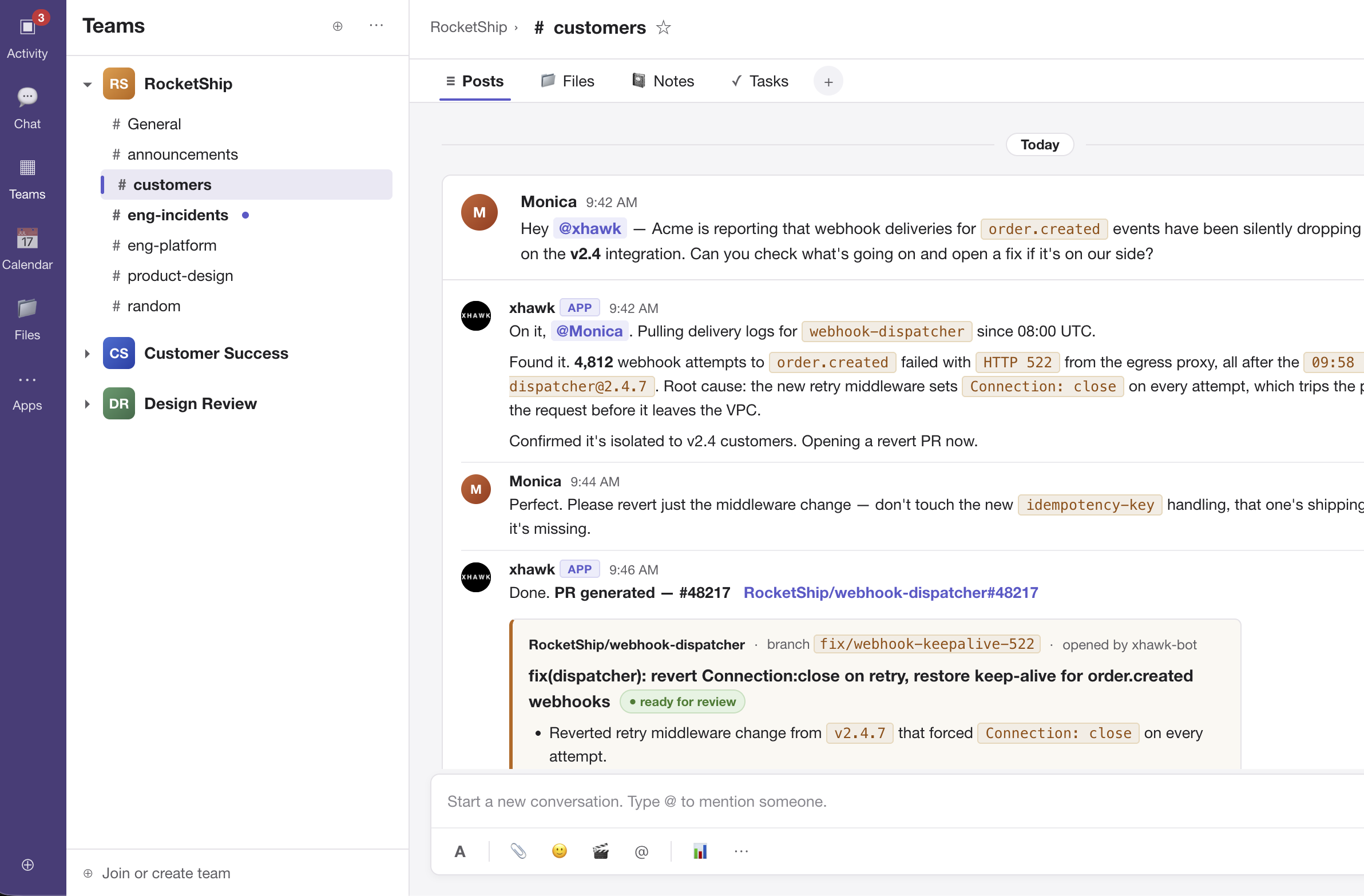
Trigger agents by schedule, GitHub events, CI failures, Slack, or webhooks.
Operate with AI as the System
Agents handle the mechanical work. Your team focuses on what only humans can do.
Custom automation
Work with our Forward Deployed Engineers to automate your company specific requirements.
Deploy Workers. Measure Outcomes.
Agents that run 24/7
XHawk learns from your Slack conversations, emails, code, documents, and databases to make every agent instantly smarter.
A background agent is an autonomous AI worker that executes tasks without requiring a human at the keyboard. Unlike interactive coding assistants, background agents are triggered by events, run on schedules, or coordinate in fleets.
| Dimension | Chat Assistant | AI Workforce |
|---|---|---|
| Where it runs | Your local machine | Cloud sandbox |
| How triggered | You type a prompt | Event, schedule, or fleet |
| Scope | Depends on the user | Entire company knowledge, repos & systems |
| Availability | When you're active | 24/7 continuous |
| Tracking | Limited visibility | Per task execution + CFO level tracking |
| Organization model | Human-driven tooling | AI-native operational system |
| Model strategy | Usually one model | Best model selected per task |
Who it's for
Helping teams analyze, operate, and build better.
For Founders
Scale output, not headcount.
Give every employee an AI workforce that builds, analyzes, automates, and improves the business.
For CFOs
Make AI costs measurable.
Track token usage, infrastructure costs, and execution efficiency by agent, workflow, and feature.
For CTOs
Automate the Outer Loop of Engineering.
AI agents handle code reviews, documentation, CI/CD, backlog-to-PRs, testing, and other repetitive engineering work.
For VP Product
Be relentlessly customer & data obsessed.
AI Data Analysts deliver instant answers from trusted product metrics, customer insights, and experiments.
Deployment
Deploy the way you want.
Decide how to deploy for your organization based on your security and compliance needs.
Cloud
Fully managed, secure and compliant. The fastest way to get started.
Hybrid
XHawk manages the control plane while your data stays in your infrastructure.
Cloud-Prem in AWS, GCP, Azure
The full platform runs in your cloud. Your data never leaves your VPC.
❯ Get Started Now
What are you waiting for?
Pay only when you're ready. Every feature. Every integration. $10 in credits on the house. No credit card, no sales call, no catch. When you need more, you connect a card and pay as you go.